
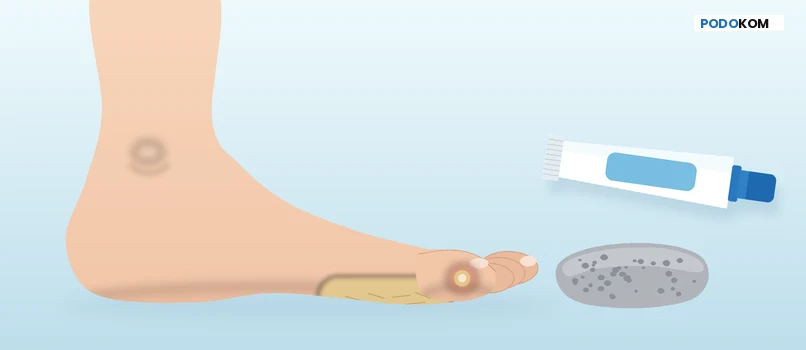
A hard, painful spot on your foot is one of the most common reasons people end up at a podiatrist. Most of the time it is either a callus or a corn. Both are thickened skin and they can look alike, yet a corn usually hurts more and needs more careful handling than a callus.
What a callus is
A callus is a broad, flat patch of hard, thickened skin. It usually forms on the parts of the foot that take the most load: the ball of the foot, the heel, the outer edge of the big toe. The skin there thickens to protect itself from repeated pressure and friction. By itself a callus is not dangerous.
Typical signs of a callus:
- a wide area of yellowish or greyish hard skin with blurred edges;
- reduced sensitivity in that area rather than sharp pain;
- a feeling of tightness or burning after a long day on your feet;
- sometimes dry skin and small cracks, especially on the heel.
What a corn is
A corn is smaller and more concentrated. It is a round, dense spot with a hard core that presses into the deeper layers of the skin. Corns tend to appear where a bone presses against the shoe: on top of the toes, on the tip of a toe, on the outer side of the little toe or between the toes. Corns between the toes are often soft because the skin there stays moist.
Typical signs of a corn:
- a small, clearly defined spot, often with a lighter or translucent centre;
- sharp, pinpoint pain when you press on it or walk in tight shoes;
- redness or irritation around it.
The pain comes from the core: every step pushes it inward like a small pebble, so even a tiny corn can make walking unpleasant.
Why they keep coming back
Both corns and calluses are a response to pressure. If the cause stays, the hard skin returns, even after it has been removed. Common causes include:
- shoes that are too tight, too narrow at the toes or with high heels;
- shoes that are too loose, so the foot slides and rubs;
- seams and rough insoles that rub in the same place;
- the shape of the foot and toes, for example hammer toes or a bunion;
- the way you walk and how your weight is spread across the foot;
- dry skin and lack of regular care.
So after the hard skin is removed, it helps to find out where the pressure comes from.
What you can do at home
A mild callus can often be kept under control with simple home care:
- soak your feet in warm water for a few minutes and gently smooth the hard skin with a pumice stone or foot file;
- do not try to remove everything at once, a little at a time is safer;
- use a moisturising foot cream every day, but not between the toes;
- choose shoes with enough room for your toes and a soft, supportive sole;
- use soft pads or protective cushions on spots that rub.
With corns, be more careful. Do not cut a corn with a blade or scissors and do not try to dig out the core yourself. It is easy to cut too deep, cause bleeding and let an infection in. Corn plasters with acids can damage healthy skin around the corn, so it is better to ask a specialist before using them.
If you have diabetes, poor circulation or reduced feeling in your feet, leave corns and calluses to a specialist. Even a small wound can heal badly, so regular professional foot care is the safer choice.
When to see a podiatrist
It is worth booking a visit if:
- a corn hurts when you walk or keeps coming back;
- you are not sure whether the spot is a corn, a callus or something else, such as a wart;
- the skin is cracked, red, swollen or bleeding;
- home care does not help after a few weeks;
- you have diabetes or another condition that affects your feet.
Pain, swelling, warmth or discharge can be signs of infection. In that case see a doctor without delay.
What happens at the appointment
The podiatrist looks at the foot, the location of the hard skin and your shoes, and asks about your daily activity. Then the hard skin is removed with professional tools, and if there is a corn, its core is carefully taken out. The procedure is usually painless, because only dead, hardened skin is removed. Many people feel relief right after the visit. Finally you get advice on care at home and on how to reduce pressure so the problem does not return quickly.
At PODOKOM in Rzeszów we remove calluses and corns, often in a single visit, and we talk about what caused them so you know how to prevent them.