
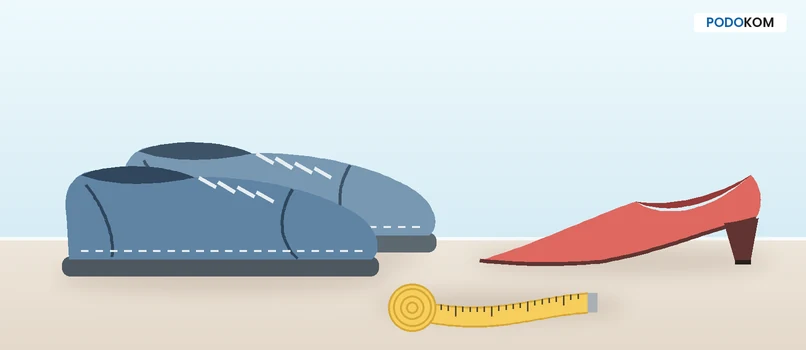
Many foot problems that bring people to a podiatrist start in the shoe cupboard. A shoe that is a little too narrow, too short or too stiff presses on the same spots every day, and over weeks and months that pressure turns into corns, calluses, painful nail edges and even ingrown toenails. You can prevent a lot of this yourself by choosing shoes with care.
How shoes affect your feet
Your foot changes shape when you stand and walk: it spreads, lengthens slightly and rolls from heel to toe. A shoe that does not leave room for this movement creates friction and pressure. The skin responds by thickening, which is how calluses and corns form. Toenails pressed from above or from the sides can thicken, darken or start growing into the skin.
Shoes that fit badly often cause or worsen:
- calluses on the ball of the foot and on the heel;
- corns on the tops and sides of the toes, especially the little toe;
- ingrown toenails, most often on the big toe, when the toe box is too narrow or too short;
- bruised or thickened nails after long walks or sport in shoes that are too small;
- blisters and rubbed skin around the heel.
Shoes are not the only cause of these problems, but they often make them worse or bring them back after treatment.
What to look for when buying shoes
What makes a shoe comfortable is how well it matches the shape of your foot; the price and an orthopaedic label matter much less. When you try shoes on, check these points:
- Leave roughly a thumb's width of space between your longest toe and the end of the shoe when you stand. Remember that your longest toe is not always the big toe.
- Your toes should lie flat and have room to move. If the sides of the shoe press on the joint of the big toe or on the little toe, the shoe is too narrow, even if the length is right.
- A rounded or square toe box is kinder to the toes than a pointed one. Pointed shoes squeeze the toes together and press on the nail edges.
- Your heel should sit firmly without slipping up and down as you walk. A slipping heel rubs and causes blisters and hard skin.
- The sole should bend where your foot bends, at the base of the toes, and not in the middle of the shoe. Very thin, hard soles give little protection on pavements.
- A low, wide heel spreads the load more evenly. High heels shift your weight onto the front of the foot, where calluses then form.
Buying and wearing shoes
- Try on and buy shoes in the afternoon or evening. Feet tend to swell a little during the day, and shoes that fit in the morning may be tight by evening.
- Always try on both shoes and walk around the shop for a few minutes. One foot is often slightly bigger than the other; choose the size for the bigger one.
- Wear the socks you plan to wear with these shoes. Thick winter socks need more room.
- Do not count on shoes "stretching" over time. If they are uncomfortable in the shop, they will probably stay uncomfortable.
- Give your shoes a rest. Alternating between two pairs lets them dry out, which matters for anyone prone to sweaty feet or fungal infections.
- Check children's shoes regularly. Children's feet grow quickly, and they do not always say that their shoes have become tight.
Shoes for sport and for long days on your feet
If you run, walk a lot or work standing, your shoes take a heavier load. Sports shoes should be chosen for the activity: running shoes for running, walking shoes for walking. Toenails often suffer in shoes that are too short for downhill walking or long runs, because the toes hit the front of the shoe with every step. Lacing matters too: laces that are tied firmly enough keep the foot from sliding forward.
Worn-out shoes lose their cushioning and shape. If the sole is worn down on one side or the inside of the shoe has lost its form, it is time to replace them.
What better shoes won't fix
Changing your shoes can stop a problem from getting worse, but it does not remove what has already formed. It is worth seeing a podiatrist if you notice:
- painful corns or calluses that keep coming back;
- a nail edge that hurts, is red or is growing into the skin;
- nails that have become thick, discoloured or press painfully in shoes;
- pain in the same spot every time you wear shoes, even comfortable ones.
If you have diabetes or poor circulation, or if the skin is red, swollen, warm or oozing, do not wait: see a doctor or a podiatrist promptly, because small injuries in these cases can become serious.
At PODOKOM in Rzeszów, we correct ingrown toenails, remove calluses and corns and thin thickened nails that press in shoes. When the cause is related to the shape of the foot or the way you walk, we work together with doctors, including an orthopaedist. We can also advise on shoes, since the right pair helps the result last.