
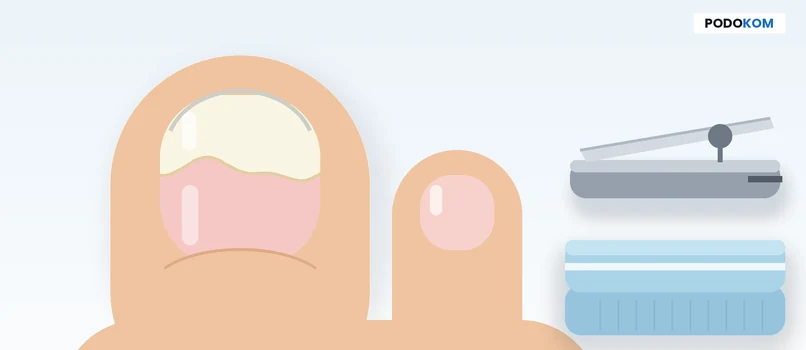
If your toenail has started to lift away from the skin underneath, you are most likely looking at onycholysis: the nail plate separating from the nail bed. The loose part will not stick back down. What you can do is stop it lifting further while a new nail grows in from the base.
In short: A lifted toenail is usually the result of a knock, pressure from shoes or a fungal infection, and sometimes another condition. Trim the loose part short, keep the area dry and stop whatever is pushing on the nail. If the cause is unclear, the nail is getting worse or the skin around it is red and sore, have it looked at.
What a lifting nail actually looks like
A healthy toenail looks pink because it is firmly attached to the bed underneath and you see the blood supply through it. Once the plate comes away, air gets in under it and the colour changes. The detached area usually turns white, yellowish or greyish, and it often starts at the free edge and creeps back towards the cuticle. Sometimes it starts at one side instead.
A few things people commonly notice:
- a pale or yellow band at the tip of the nail that gets wider over the weeks
- a gap under the nail where dirt collects, even right after a shower
- a hollow sound or a slight wobble when you press on the tip
- a darker patch under the nail, sometimes after a bruise that never quite faded
- the nail catching on socks or tights
It is not usually painful on its own. That is part of why people leave it for months. Meanwhile the gap under a lifted nail stays warm, damp and hard to clean, and fungus or bacteria settle there easily.
"It doesn't hurt, it just looks bad, so I kept painting over it."
Covering it with polish is understandable, but it hides the very changes you would want to keep an eye on, and the nail cannot be checked properly under a layer of colour.
Why toenails come away from the bed
Often two causes work together.
The most common cause is a knock: dropping something on a toe, stubbing it hard, or a long run downhill in shoes that are a size too small. Repeated small knocks count too: the big toe hitting the front of a shoe thousands of times during a walk does real damage over time. Sometimes a bruise forms under the nail first and the plate lifts later.
Fungus can grow under the nail and push it up from the bed. The nail then often becomes thicker, crumbly or discoloured as well. It can also go the other way round: a nail that has lifted after an injury is easier for fungus to get into.
Then there is everyday pressure. Tight or pointed shoes, high heels and sports footwear that lets the foot slide forward all press on the tip of the nail day after day.
Feet that stay damp for long periods, frequent long soaks, strong chemicals and aggressive cleaning under the nail with sharp tools can all loosen the attachment.
Skin conditions such as psoriasis can affect the nails, and some general health problems and medicines can too. Sorting that out is a job for a doctor. If several nails lift at once without any injury, or fingernails are affected as well, mention it to your GP or a dermatologist.
What you can safely do at home
You cannot glue the nail back, and pulling or tearing off the loose part is a bad idea: it can damage the bed and the skin around it. What you can do is make life easier for the nail while it grows out.
- Trim the detached part short with clean nail clippers, cutting straight across. Short nails catch less and lift less.
- Keep the foot dry. Dry carefully between the toes and around the nail after washing, and change damp socks.
- Do not dig under the nail with metal tools or cotton buds to clean it. You can push the gap wider that way.
- Look at your shoes. There should be room in front of the longest toe, and the shoe should hold the foot so it does not slide forward.
- Leave the polish and gel off for now, so you can actually see how the nail is changing.
- Wear your own flip-flops in pools, gym showers and changing rooms.
After that it is mostly waiting. The new healthy nail grows from the base and pushes the old one forward, and on a big toe this can take up to a year. You will often see a clear line between the attached pink part and the loose pale part, and that line should slowly move towards the tip.
When to see a podiatrist, and what happens there
It is worth booking a visit if the nail keeps lifting further, if it is thick, crumbly or changing colour, if the skin around it is red, swollen or painful, or if you are not sure what you are looking at. People with diabetes or poor circulation should not wait and should not trim a problem nail themselves.
A dark streak or patch under a nail that was not caused by an injury you remember should be shown to a doctor soon.
At the appointment a podiatrist looks at the nail and the skin around it and asks how it started: a knock, new shoes, sport, other nails affected. They clean the nail and remove the part that is no longer attached, so it stops catching and lifting further. A thickened plate can be thinned. If a fungal infection is suspected, a lab test can confirm it, and if the picture points to a skin or general health condition, you will be advised to see a doctor.
At PODOKOM in Rzeszów, cleaning of a nail with onycholysis is one of our routine procedures, and our gallery shows how such nails look before, during and months after treatment. For a badly damaged nail, nail prosthetics can restore the look of the plate, but only where the nail and skin allow it.
FAQ
Will my toenail reattach by itself?
No. The part that has separated stays separated. A new nail has to grow out from the base, and if the cause has been dealt with, it should grow back attached.
Is a lifting toenail always fungus?
No. Injury and pressure from shoes are very common causes. Fungus is one possible reason, and it can also move in after the nail lifts, so a check is useful if you are unsure.
Should I cut off the loose part?
Trim it short and straight across with clean tools, but do not rip it off or cut into the attached part. If most of the nail is loose, let a podiatrist deal with it.
Can I wear nail polish over it?
Better not while it grows out. Polish and gel hide changes in colour and thickness, and many nail services are not done on a nail with onycholysis.